
When does a roof need replacing instead of repair?
A roof usually needs replacing when the damage is spread across several slopes rather than one spot. Brittle or curling shingles, heavy granule loss, hail bruising on every face and leaks that keep moving are the common signs. If the problem is local and the roof still has life left, a repair is the better buy.
- Granules in the gutters. The mineral coating that shields the asphalt from the sun is washing off. Once it goes, the shingle dries out quickly in a Texas summer.
- Curling, cupping or cracking. Shingles that have lost their flexibility stop sealing down, and the next strong south wind lifts them.
- Hail bruising on every slope. A few hits can be repaired. Bruising across the whole roof usually can’t, and it is often an insurance matter.
- Repeat leaks. A different leak every few months means you are paying for a new roof in installments.
- Soft spots, or daylight in the attic. Both point to the decking, which can only be fixed properly with the old roof off.
Our repair vs. replace guide walks through the decision in more detail, including why shingle matching on an older roof can tip a large repair toward replacement.
What happens during a roof replacement?
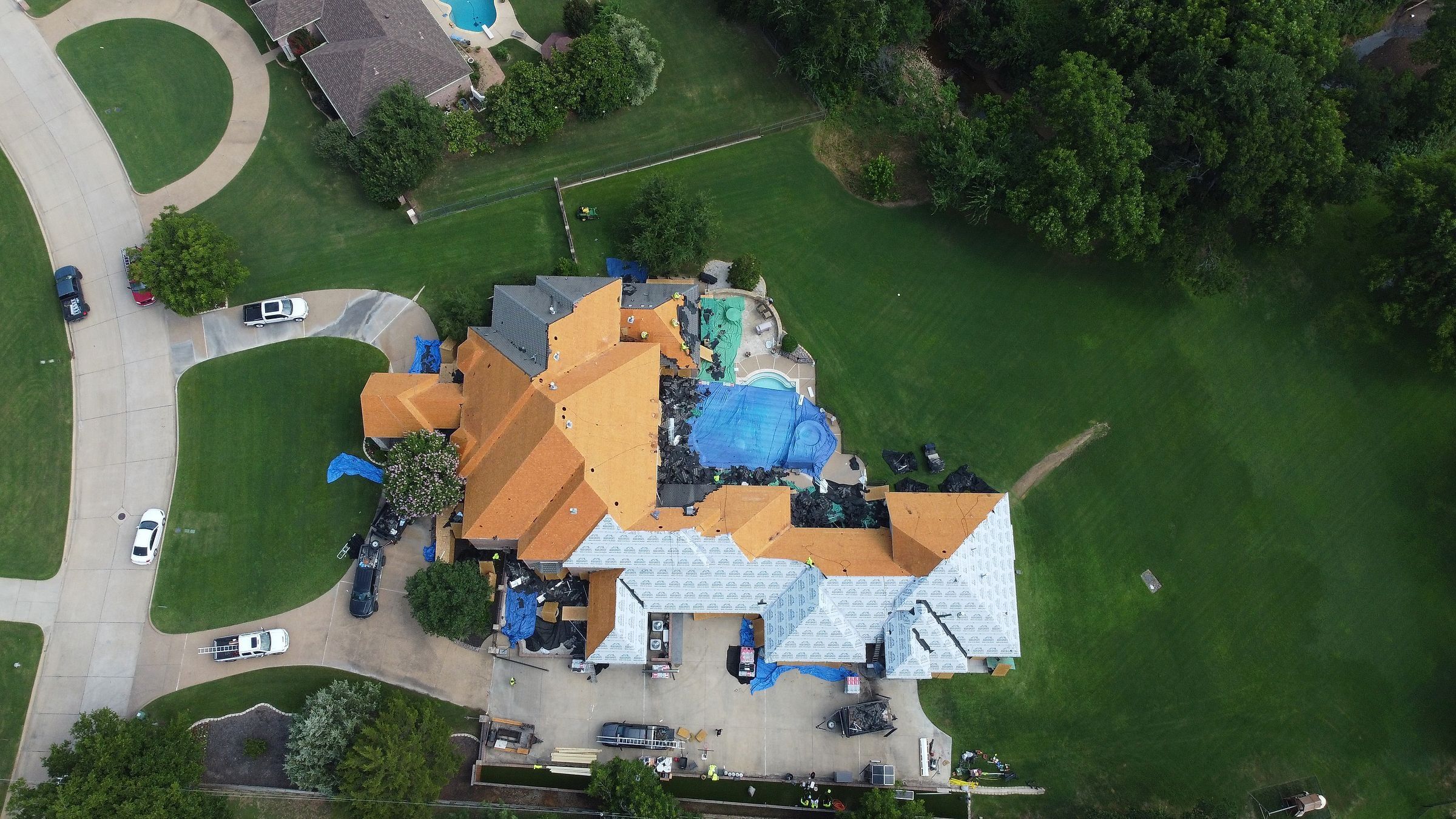
A replacement follows the same order on every house: inspect and measure, choose materials, sign a written estimate, permit and schedule, tear off, repair the deck, install the new roof system, then clean up and walk the job with you. Each step below is something you should be able to see happen on your own roof.
- Free inspection and measurement. We walk the roof, check the attic where we can get in, photograph flashing, vents and every penetration, and measure each slope.
- Material selection. You see real samples and the trade-offs between standard architectural and Class 4 impact-resistant shingles.
- Written estimate. Scope, materials by name, how any rotten decking is priced, and warranty terms. Nothing important is left verbal.
- Permit and scheduling. We set the start date against the forecast. A roof should not be opened with rain on the way.
- Tear-off and deck repair. Landscaping covered, old roof removed, bad decking replaced.
- Installation. Underlayment, flashing, shingles and ventilation, in that order.
- Cleanup and walkthrough. Debris hauled off, property swept, and a final walk of the job with you.
Tear-off and decking
Every replacement is a full tear-off: we take the roof down to the deck and leave no old shingles, felt or underlayment behind. An overlay adds weight, holds heat and hides the condition of the plywood underneath.
With the old roof off, we walk the whole deck. Soft, delaminated or rotted sheets are replaced before anything new goes down, and we show you the damaged sheets first. Your estimate explains how decking is priced, so nothing lands on the bill that you have not seen.
Underlayment, flashing and shingles
Shingles are the last layer, not the only one. A complete installation puts underlayment over the bare deck, with ice-and-water membrane in valleys and around penetrations where water concentrates. Then come drip edge, a starter course, the shingles, new pipe boots, flashing at walls and chimneys, and ridge vent. Reusing tired flashing on a new roof is a common shortcut and a common source of leaks a year later. Your estimate names each component, so you can compare bids line by line.
Attic ventilation
If the attic can’t breathe, summer heat bakes the shingles from underneath and winter moisture condenses on the deck. Many older Arlington homes have less intake and exhaust than the roof needs. We check ventilation during the inspection and, if it falls short, price the correction as its own line so you can decide.
Which roofing materials work best in Arlington?
Most Arlington homes are re-roofed with architectural asphalt shingles. Class 4 impact-resistant shingles cost more but stand up better to hail and can earn an insurance premium credit. We are CertainTeed certified, and we price the options side by side so you are comparing real numbers for your roof.
| Option | Why homeowners choose it | Trade-offs |
|---|---|---|
| Architectural asphalt shingles | Dimensional look, wide color range, proven in North Texas heat | Standard shingles bruise in serious hail |
| Class 4 impact-resistant shingles | Highest class in the UL 2218 impact test; may qualify for a premium credit | Higher up-front cost; the credit varies by insurer |
| Metal | Long service life, reflects summer heat | Highest up-front cost; profile and gauge matter in hail |
On the insurance credit: the Texas Department of Insurance says a Class 4 roof covering receives the highest premium credit, but the amount is set by each insurance company (TDI). For a TWIA policy the installer completes TDI form PC068, and other insurers may use their own form. Ask your agent for the dollar figure before you decide. Our Class 4 shingles page and roofing materials overview go further, including metal roofing.
Many Arlington neighborhoods also need HOA approval for color and material. We can give you the product name, color and spec sheet that most boards ask for.
How does an insurance-funded roof replacement work?
If hail or wind is the reason you need a new roof, the order matters: inspection and photos first, then the claim, then the adjuster’s visit, then the replacement. Your insurer pays for covered storm damage minus your deductible. It will not pay for a roof that is simply old or worn out, so we tell you which one you have.
Our part is documentation and coordination. We photograph the damage slope by slope, meet the adjuster at the property, and explain the scope your insurer approves. We are not a public adjuster and do not negotiate your claim for you; the claim is between you and your insurer. Two points catch people out:
- The deductible is yours to pay. Texas law makes it illegal for a contractor to waive a deductible or promise a rebate for any part of it (TDI). We never do. See roof deductibles in Texas.
- Payment often comes in two parts. With replacement cost coverage, the first payment is partial and the rest follows once repairs start (TDI). Our page on ACV vs. replacement cost explains why.
Start with our roof insurance claims guide if a storm is involved.
Who handles the permit and the cleanup?
In Arlington, roofing work on more than 10% of the roof surface needs a City permit, and only contractors registered with the City can pull one (City of Arlington). Roof Experts is registered with the City of Arlington. The permit should be posted on the front of the property before work starts, so you can check it from the street.
Other DFW cities set their own rules. Our roof permit guide covers Arlington and Fort Worth.
Tear-off is messy work. We cover landscaping and the areas below the roof edge, keep debris contained, and sweep the drive, lawn and beds with a magnet for nails before we leave. The last step is a walk around the house with you to look at the finished roof together.
What warranty and payment options come with a new roof?
Every new roof we install carries our 5-year workmanship warranty, and we go through the terms in writing before you sign. For payment, we offer in-house financing in specific situations, and third-party financing is also available.
Details are on our payments page, or ask when we quote. Pricing is per job, after measurement; the DFW roof replacement cost guide explains what drives the price.
We have worked from one office, at 4275 Little Rd #202 in Arlington, since 2017. The company that installs your roof is the one you call if something needs a second look. Book a free inspection at (817) 754-9484 or request one online.
Sources
- Texas Department of Insurance, Products qualifying for impact-resistant roofing credits
- Texas Department of Insurance, Insurance and your roof: What to know when buying a policy or filing a claim
- Texas Department of Insurance, New state law cracks down on roof scams
- City of Arlington, Tips for Choosing a Contractor in Arlington (June 3, 2025)