
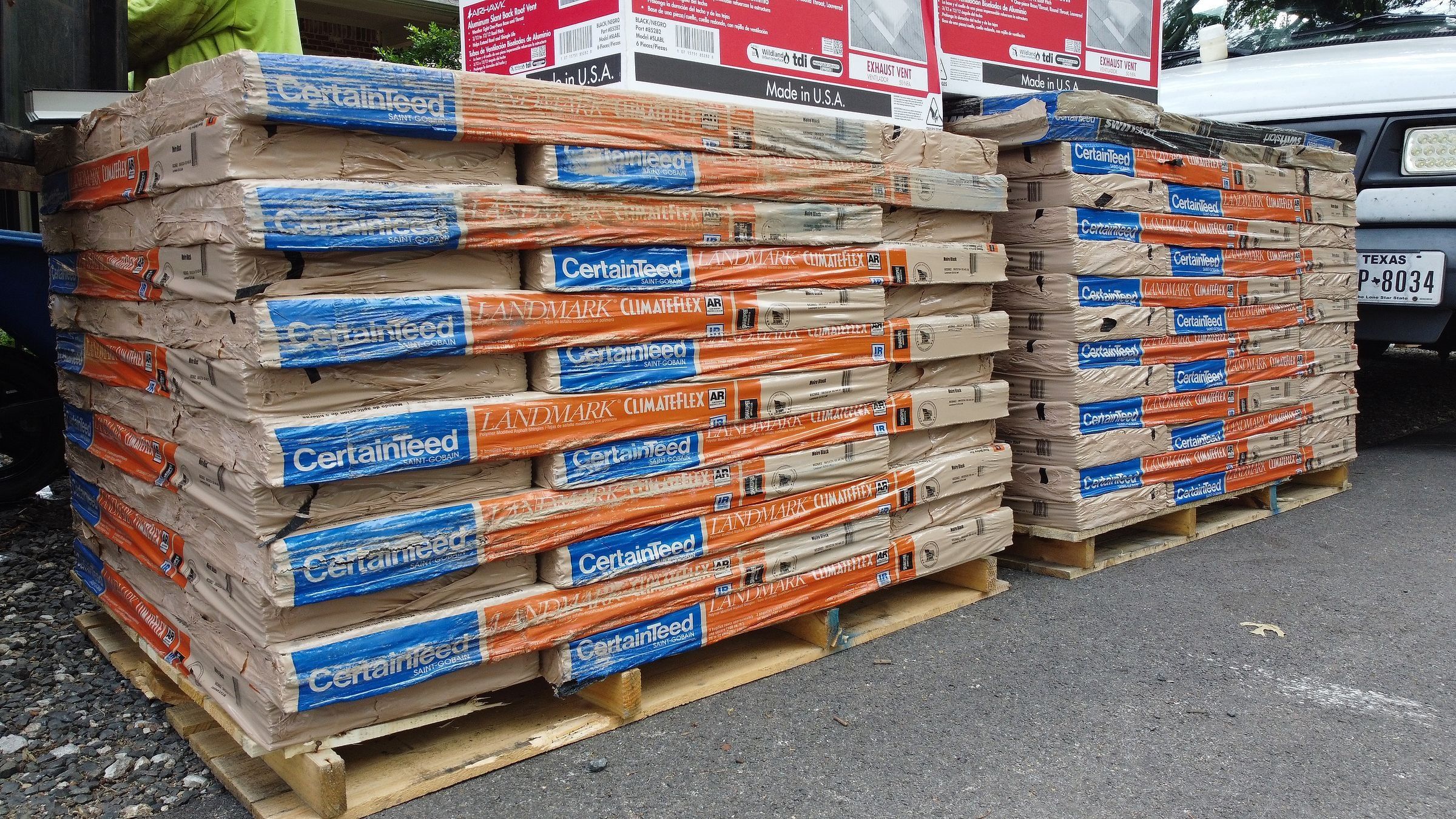
What a Class 4 rating means
Class 4 is the top rating under UL 2218, the standard lab test for how roof coverings stand up to impact. Steel balls of increasing size are dropped twice on the same spot, and the shingle passes a class if no crack or tear shows on its back. Class 4 uses the largest ball, 2 inches across.
The Insurance Institute for Business and Home Safety summarizes the four classes this way (IBHS, August 2014):
| UL 2218 class | Steel ball diameter |
|---|---|
| Class 1 | 1.25 in. |
| Class 2 | 1.50 in. |
| Class 3 | 1.75 in. |
| Class 4 | 2.00 in. |
Each ball is dropped from the height needed to match the energy of a hailstone that size. Granule loss and marks on the top surface alone don’t count as a failure under the standard. Manufacturers reach Class 4 in different ways: some add a reinforcing mesh to the back of the shingle, others modify the asphalt with polymers.
Do Class 4 shingles lower insurance in Texas?
Often, yes. The Texas Department of Insurance says a Class 4 roof covering receives the highest premium credit, but the amount for each class is set by each insurance company. That means the dollar savings on your policy can only come from your agent.
Some history explains why the credit exists. In 1998, TDI’s Bulletin B-0024-98 announced mandatory roof covering credits for UL 2218 roofs, set by rating territory. TDI’s current guidance describes the discount as company by company. In September 2026, TDI’s Bulletin B-0008-26 encouraged insurers to offer meaningful, actuarially supported discounts for loss-mitigation measures, naming impact-resistant roofing. The bulletin encourages; it does not set an amount.
What to ask your agent, in writing:
- What is my yearly premium credit for a Class 4 roof, in dollars?
- What proof do you need: TDI form PC068 or your own form?
- Does accepting the credit add a cosmetic hail damage exclusion to my policy?
- Does the credit change my wind and hail deductible or how an older roof is valued?
The paperwork that gets you the credit
Insurers need proof of what was installed. The usual document is TDI form PC068, the Impact-Resistant Roofing Installation Form. The roofing company fills in the manufacturer, brand name, year made and installation date, and certifies the impact class it installed to manufacturer specifications.
The form also asks the installer to confirm that the packaging shows the UL 2218 classification and that a label from the packaging went to the owner. Keep that label and the original form with your house papers, and send your insurer a copy. If you sell the house, the next owner will want them too.
Are Class 4 shingles hail-proof?
No roof is hail-proof, and Class 4 shingles can still be damaged by large or wind-driven hail. The rating tells you how the shingle did in a controlled test on new material. Weathered shingles, temperature swings and hail falling at an angle are all different from the lab.
Independent testing backs that up. In IBHS’s 2014 tests on shingles bought from local suppliers, Class 4-rated products generally outperformed basic shingles, polymer-modified products did best, and yet none of the products passed every impact location at the larger ball sizes (IBHS). NRCA has cautioned that impact ratings are not necessarily true indicators of hail resistance (Professional Roofing, October 2008). Expect fewer claims and less damage, not none.
One more trade-off: TDI notes that a roof discount can come with an exclusion for cosmetic damage, so read the terms before you accept it.
Are they worth it on your house?
Class 4 tends to pay off on homes you plan to keep, in parts of DFW that see repeated hail, with an insurer that offers a real credit. It makes less sense if you’re selling soon or your insurer’s credit is small. The way to decide is to put the upgrade cost next to the yearly credit.
We are CertainTeed certified, and CertainTeed publishes UL 2218 Class 4 ratings for several of its shingle lines; see our CertainTeed shingles page. On your free inspection we can price standard and Class 4 shingles on the same written scope so you see the difference on your actual roof. What drives the price of each is explained in our roof replacement cost guide.
If hail has already hit your roof, start with hail damage roof repair in Arlington and our deductibles guide. To price an upgrade, book a free inspection or call (817) 754-9484.
Sources
- Texas Department of Insurance, Roofing discounts
- Texas Department of Insurance, Commissioner's Bulletin B-0024-98 (March 18, 1998)
- Texas Department of Insurance, Commissioner's Bulletin B-0008-26, Premium discounts for loss mitigation (September 16, 2026)
- Texas Department of Insurance, Form PC068 Impact-Resistant Roofing Installation Form
- Texas Department of Insurance, Metal roofs and home insurance: 4 key facts (August 10, 2026)
- IBHS, Relative Impact Resistance of Asphalt Shingles: Summary of UL 2218 Impact Tests (August 2014)
- NRCA Professional Roofing, Impact testing may not replicate products' hail resistances (October 2008)