


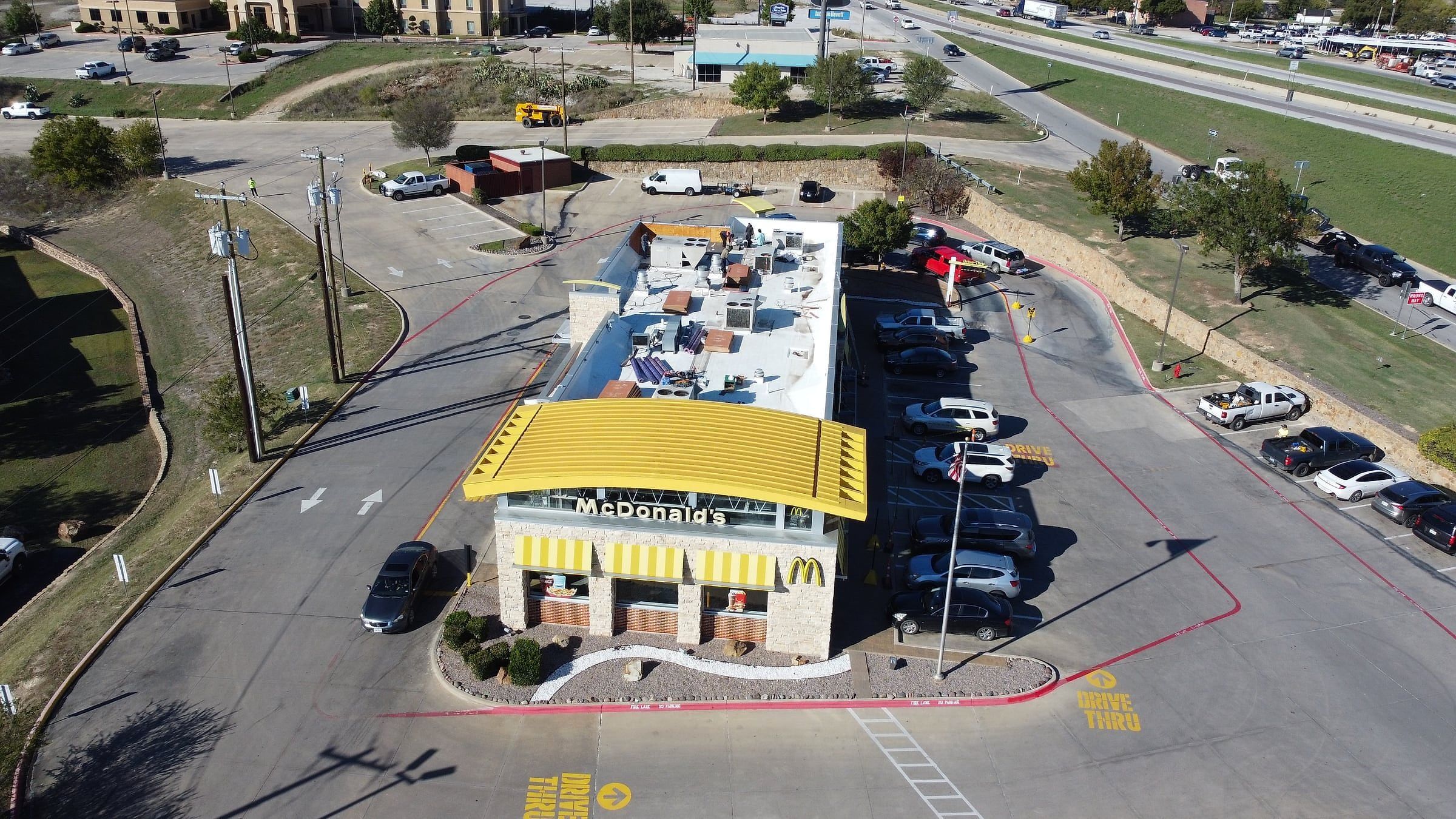
What is PVC roofing?
PVC is a reinforced thermoplastic membrane installed over insulation and cover board on low-slope roofs, with seams welded by hot air the same way TPO’s are. The difference is chemistry. PVC holds up to animal fats, cooking oils and many industrial chemicals that soften or swell other membranes. Like TPO, it’s usually white and reflective.
A PVC roof is an assembly, not just a sheet. From the deck up it is usually: roof deck, insulation (tapered where water needs to drain), cover board, then the PVC membrane, with welded flashings at walls, curbs, pipes and drains, grease containment at each kitchen fan, and metal at the roof edge.
Which buildings need a PVC roof?
Specify PVC when grease or chemicals land on the roof: restaurants and strip centers with food tenants, commercial kitchens, grocery stores, food processing, labs and some manufacturing plants. If exhaust fans discharge onto the membrane, a standard TPO or EPDM sheet may degrade early. A grease-containment unit at each fan is part of a good PVC scope.
| Usually a good fit | Think twice |
|---|---|
| Restaurants and strip centers with food tenants | Offices, retail and warehouses with no grease or chemical exposure (see TPO roofing) |
| Commercial kitchens, grocery stores, food processing | Roofs with wet insulation or a damaged deck that needs repair first |
| Labs and plants with chemical or oil exhaust | Sound, dry roofs that could be restored with a coating |
How do we install a PVC roof?
PVC is attached in one of three ways: mechanically fastened through the insulation into the deck, fully adhered with bonding adhesive, or induction-welded to plates under the sheet. Every seam is hot-air welded, then probed. Where the new sheet would touch old asphalt roofing or certain foam insulation, the manufacturer’s separator layer goes in first.
| Method | How it works | Typically chosen when |
|---|---|---|
| Mechanically attached | Fasteners and plates hold the insulation and membrane to the deck; seams are welded over the fastener rows | Steel or wood decks where fastening is approved |
| Fully adhered | The membrane is bonded to the cover board with adhesive | Higher wind-uplift needs, or where a smoother finish is wanted |
| Induction-welded | Plates are fastened under the sheet, then bonded to it by induction heat | Where the manufacturer’s assembly calls for it |
We install PVC systems from GenFlex, Elevate (Holcim) and other manufacturers, and we are Elevate (Holcim) and GenFlex certified. Your written scope names the product, the attachment method and the reason we chose it for your deck.
What should a PVC roof scope include?
A complete PVC scope lists tear-off or recover (with a separator sheet if required), tapered insulation to drains, cover board, membrane thickness and attachment method. It also covers grease containment at kitchen fans, flashing at curbs, pipes and walls, edge metal, drains and walkway pads. Compare bids line by line against this list.
| Scope item | What it means |
|---|---|
| Tear-off or recover | Remove the existing roof, or install over it where allowed, with a separator sheet if required |
| Deck repairs | Replace or reinforce damaged deck areas |
| Insulation and taper | Type, thickness and taper plan to the drains |
| Cover board | Board under the membrane that protects the insulation from hail and foot traffic |
| Membrane thickness | Stated in mils |
| Attachment method | Mechanically attached, adhered or induction-welded |
| Grease containment | A containment unit at each kitchen exhaust fan |
| Flashings | Walls, curbs, pipes, drains and scuppers |
| Edge metal and walkway pads | Perimeter metal and protected service paths to fans and units |
| Closeout | Photos and a care plan for the grease areas |
Those items also set the price. Roof size, wet insulation found by the survey, separator sheets, deck repairs, taper and the number of exhaust fans move the number more than the membrane does, which is why we price each roof after we inspect it.
Recover or tear-off?
A recover installs new PVC over the existing roof, which saves tear-off cost and disruption. It only works when the existing roof is dry, there’s a single existing layer, the deck is sound, and code and the manufacturer allow it, usually with a separator sheet over old asphalt. A moisture survey decides. Wet insulation has to come out.
| Recover may work when… | Tear-off is needed when… |
|---|---|
| The moisture survey shows dry insulation | Insulation is wet across large areas, often around grease-soaked fan areas |
| There is one existing roof layer | Two roof layers are already in place |
| The deck is sound and fastening tests pass | The deck is damaged or corroded |
| The manufacturer approves the assembly and separator | Drainage has to be rebuilt with new taper |
PVC vs TPO: what’s the difference?
Both are white, heat-welded single-ply membranes. PVC costs more but resists grease and chemicals far better. TPO is the general-purpose choice for offices, retail and warehouses. If your roof has no grease or chemical exposure, TPO is usually the better value. If it does, PVC avoids early failure around the exhaust fans.
| PVC | TPO | |
|---|---|---|
| Seams | Hot-air welded | Hot-air welded |
| Grease and chemicals | Strong resistance | Limited |
| Surface | White, reflective | White, reflective |
| Relative cost | Higher | Lower |
| Usual fit | Restaurants, kitchens, food processing, labs | Offices, retail, warehouses, multifamily |
Compare TPO vs PVC vs EPDM side by side, or read more on TPO roofing and EPDM roofing.
How long does a PVC roof last, and what warranty comes with it?
PVC life depends on the formulation, thickness, the assembly under it and how well grease is managed, so we state it for your roof rather than as a slogan. Roof Experts, LLC gives a 2-year workmanship warranty on PVC roofs, covering our labor. Manufacturer NDL warranties available. Your written scope says which options apply.
Most restaurant roof problems come from grease pooling around exhaust fans, clogged drains and failed flashings. Keeping a PVC roof in service means:
- Repairs: clean the area, then hot-air weld a matching PVC patch or flashing.
- Grease areas: service the containment units, clear residue from the membrane and check the seams near each fan.
- Drains: keep drains and scuppers clear so water and residue don’t pond.
- After hail: inspect the membrane and flashings and document any damage for a claim. See roof insurance claims.
More on why commercial roof maintenance matters.
What does a PVC roofing project look like?
A PVC project runs in five stages: we inspect the roof, the exhaust locations and the drainage, give you a written itemized scope with options, schedule around kitchen hours and tenants, install with fire-safe procedures and daily cleanup, and close out with photos and a care plan for the grease areas. Nothing starts before you have the scope in writing.
- Inspect. We walk the roof, map the exhaust fans and drains, and run a moisture survey or core cuts where needed.
- Scope in writing. You get an itemized scope with options, such as recover or tear-off.
- Schedule. We plan the work around kitchen hours and tenants and protect entrances.
- Install. We follow fire-safe procedures for hot-air welding, probe every seam and clean up daily.
- Close out. You get photos, your written workmanship warranty and a care plan for the grease areas.
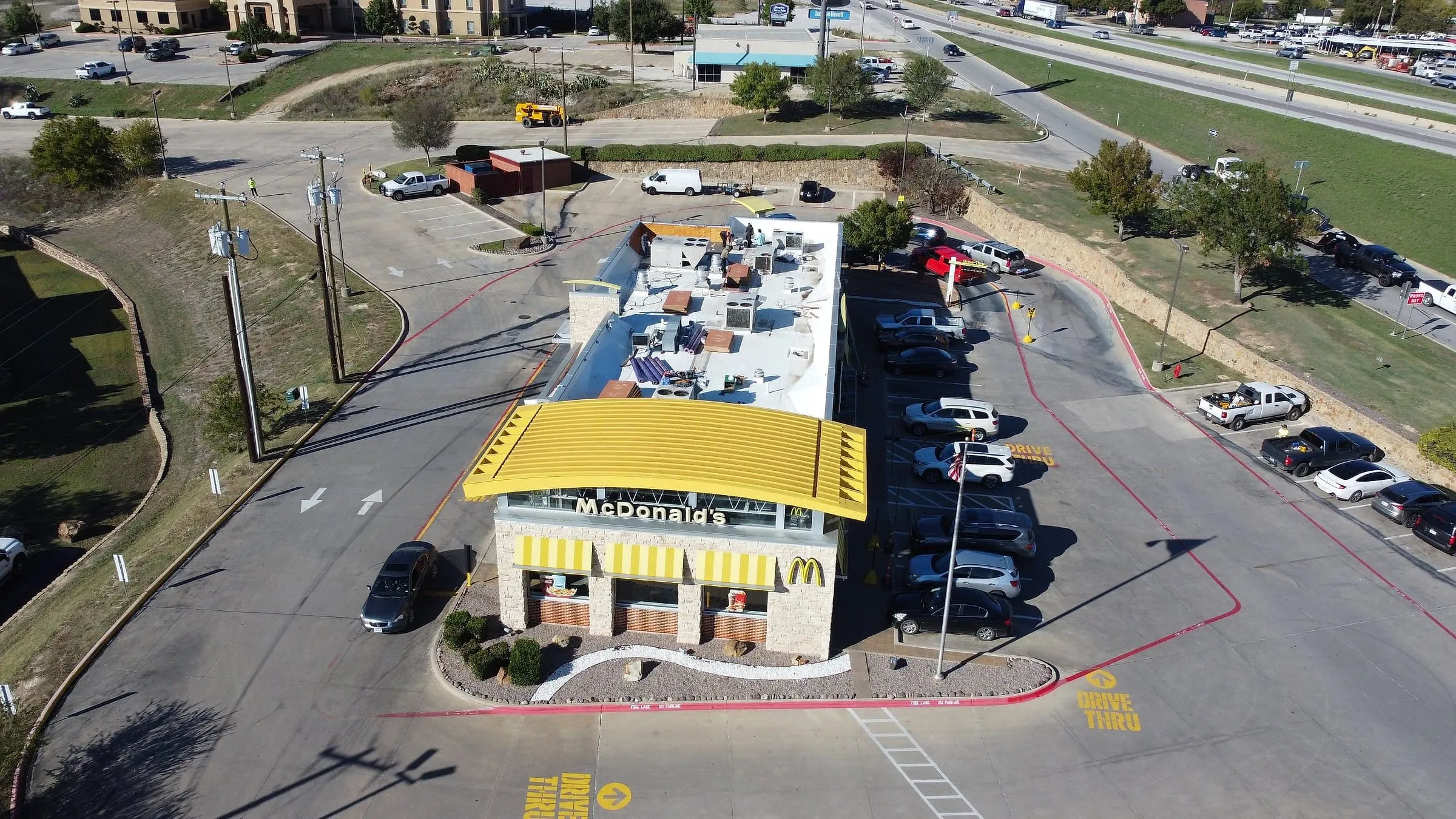
Recent PVC roofing project in North Texas
This recent job is a Roof Experts, LLC PVC roof on a restaurant in Decatur, TX. Restaurants are where PVC earns its place over TPO, because kitchen exhaust puts grease on the roof and PVC resists it better. More restaurant, kitchen and industrial jobs will appear here as their photos are cleared for use.
When is PVC the wrong choice?
PVC is a poor fit where the roof sees no grease or chemical exposure and budget matters, where wet insulation or a damaged deck needs repair first, or where a sound roof could be restored with a coating. TPO or a coating may serve those roofs better. We say so in the written scope before you sign.
| Situation | Why PVC is a poor fit | What to look at instead |
|---|---|---|
| No grease or chemical exposure, and budget matters | You pay for resistance the roof doesn’t need | TPO roofing |
| Wet insulation or a damaged deck | Any new membrane over trapped moisture or a weak deck fails early | Tear-off of wet areas and deck repair first, whichever system follows |
| Sound, mostly dry roof that is simply aging | Replacement may not be needed yet | Silicone roof coatings |
Roof Experts, LLC installs TPO, PVC, EPDM and modified bitumen roofs and applies silicone and acrylic coatings, so the system in your written scope is the one that fits the roof.
Why choose Roof Experts, LLC for PVC roofing?
Roof Experts, LLC has been based in Arlington and serving Dallas–Fort Worth since 2017. We’re GenFlex certified, insured, and registered with the City of Arlington. We map exhaust fans and drains before we scope the roof, and every proposal is itemized in writing. We’re rated 4.9 on Google.
Get a commercial roof assessment: call (817) 754-9484 or send the property address and the number of exhaust fans through our contact page. Our office is at 4275 Little Rd #202, Arlington, TX 76016.