
Why do gutters matter so much in North Texas?
Gutters move roof water away from the house. When they fail, the damage rarely shows on the roof. It shows in rotted fascia, stained siding, washed-out beds and, most expensively, foundation movement. North Texas clay soil swells when wet and shrinks when dry, and water dumped at the base of a wall drives that cycle.
The damage tends to follow a pattern:
- Foundation movement. Repeated soaking and drying of the soil next to the slab is what causes cracks and doors that stick.
- Fascia and soffit rot. Water overtopping a blocked gutter runs down the board behind it. By the time paint peels, the wood is often already soft.
- Siding and paint damage. Constant splashing on one section of wall wears out siding and exterior paint years early.
- Roof edge damage. A backed-up gutter pushes water under the shingle edge and into the decking.
- Erosion. Concentrated discharge scours flower beds and undermines walkways.
What are the signs your gutters need repair or replacement?
Look during a heavy rain and again on a dry day. Water spilling over the front, sagging runs, dripping joints, rust, cracks, holes and gutters pulling away from the house all mean the system is not doing its job. So do peeling paint on the fascia, soil erosion below, and plants or nests growing inside the gutter.
Other signs worth noticing:
- Nails or hangers backing out of the fascia
- Bent or dented sections, often after hail
- Mildew or staining on the wall below a corner
- Water pooling at the foundation after rain
- Downspouts that empty right next to the slab
A single bad joint or a loose hanger is a repair. A system that sags, leaks at every joint and overflows even when clean has usually reached the end of its life. Our post on five common gutter problems in North Texas goes through the usual culprits.
How should a gutter system be sized?
Gutters and downspouts have to carry what the roof sheds in a hard Texas downpour. A large roof area, a steep pitch, or a long run with few downspouts can deliver more water than a standard gutter can hold, and it overflows no matter how clean it is. If your gutters spill over while clear, undersizing is a likely cause.
The layout matters as much as the size. Gutters need a steady fall toward the outlets so water doesn’t sit, hangers need sound wood to hold onto, and downspouts should discharge well clear of the foundation.
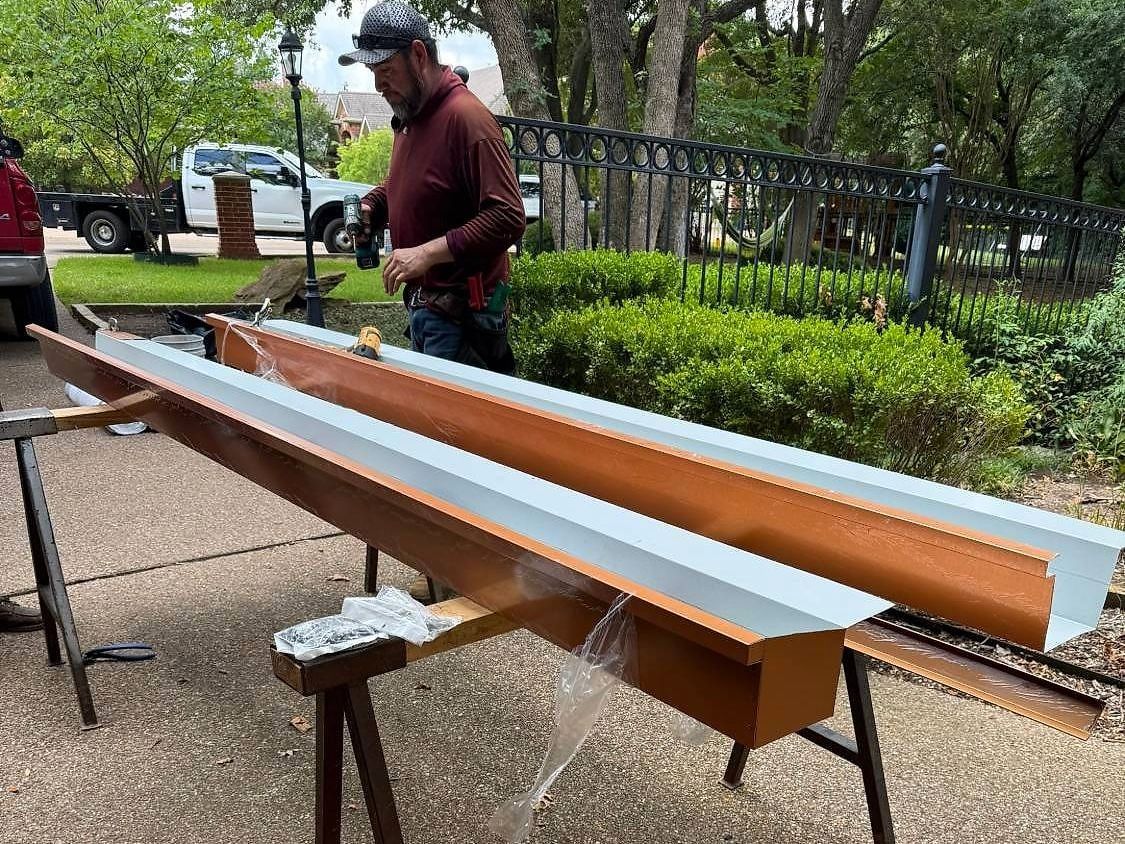
We install pre-finished aluminum gutters in 5 inch and 6 inch sizes, half-round gutters, copper gutters and copper scuppers, and custom box gutters fabricated from sheet metal for commercial buildings, along with scuppers and downspouts to match.
Should gutters be replaced with a new roof?
If the gutters are near the end of their life, the roof replacement is the best time to do it. The drip edge and gutter can be detailed together, the crew and equipment are already there, and you avoid disturbing a new roof edge later. If the gutters are still sound, we protect them during the roof work and leave them in place.
We check the gutters, fascia and downspouts during every roof inspection, so you know their condition before you decide. The roof replacement page explains how the full job runs, and how gutters protect your roof explains the connection between the two.
Are storm-damaged gutters part of a roof claim?
Often, yes. Hail that damages a roof usually dents the gutters and downspouts too, and those dents help show an adjuster how large the hail was and which way it came from. We photograph the gutters as part of every storm inspection and include them in the documentation for your claim.
The claim itself is between you and your insurer. Our storm damage page explains the process after hail. To book a free estimate for gutter work, call (817) 754-9484 or request one online.