


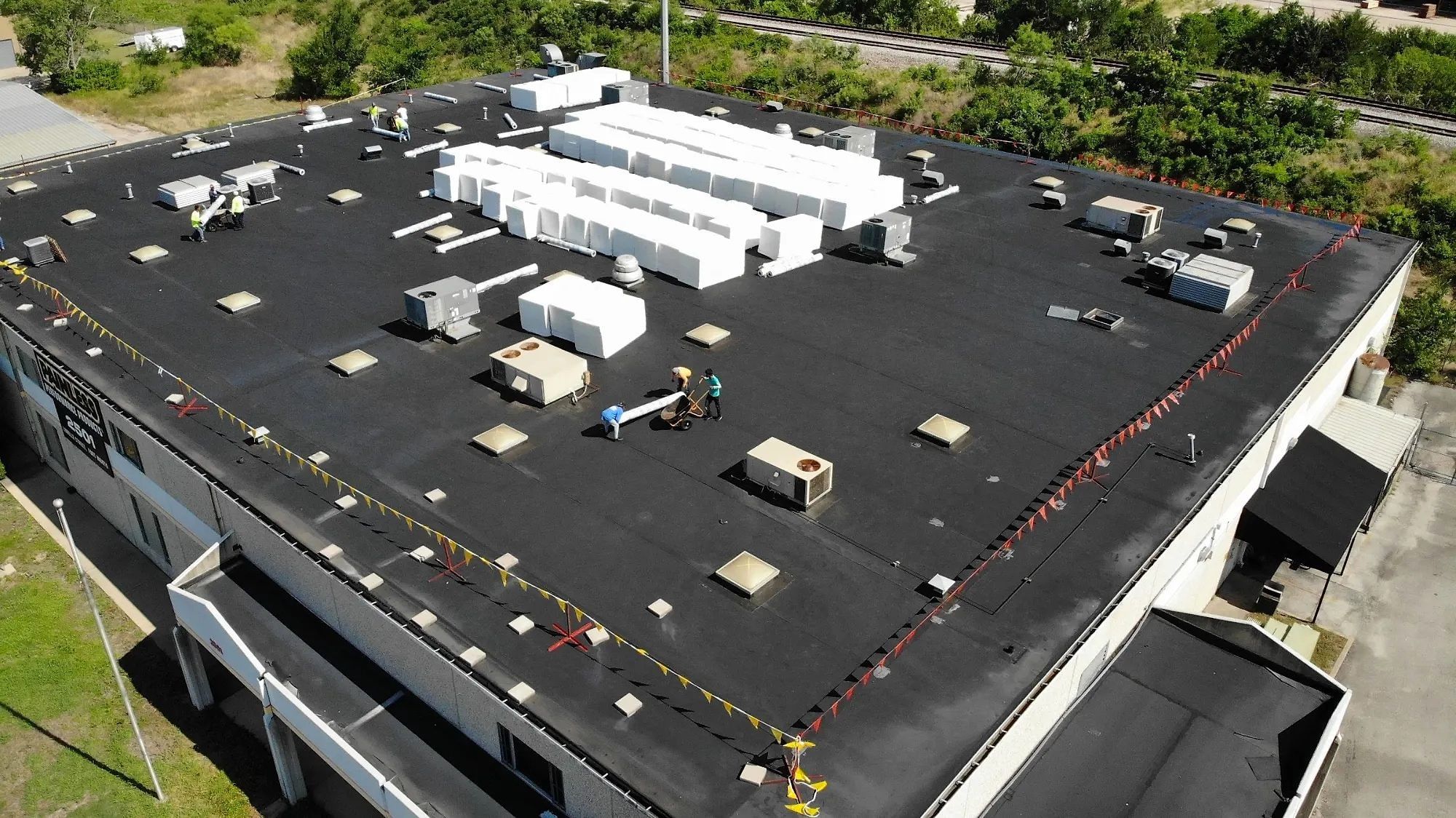
What is EPDM roofing, and which buildings is it right for?
EPDM (ethylene propylene diene monomer) is a rubber sheet that’s fully adhered, mechanically fastened or ballasted over insulation. Unlike TPO and PVC, its seams are joined with tape and adhesives rather than heat-welded. It’s usually black, and white versions exist. It’s common on older warehouses, schools, churches and industrial buildings around DFW.
An EPDM roof is an assembly, not just a sheet. From the deck up it is usually: roof deck, insulation (tapered where water needs to drain), cover board, then the EPDM membrane, with taped seams, flashings at walls, curbs, pipes and drains, termination bars, and metal at the roof edge.
| Usually a good fit | Think twice |
|---|---|
| Buildings that already have EPDM, where a repair or a matching replacement makes sense | Restaurants and kitchens with grease or oil exhaust on the roof (see PVC) |
| Warehouses and industrial buildings with little cooling below the roof | Occupied, air-conditioned space under a black roof, unless a reflective option is planned |
| Owners who want simple, low-cost patching over the roof’s life | Roofs with wet insulation that hasn’t been removed |
Where EPDM doesn’t fit, see when EPDM is the wrong choice below.
How we install EPDM roofs
EPDM is attached in one of three ways: fully adhered to the cover board with bonding adhesive, mechanically fastened through the insulation into the deck, or ballasted with stone or pavers where the structure can carry the weight. Seams are joined with primer and seam tape, and the manufacturer’s approved assembly sets the method.
| Method | How it works | Typically chosen when |
|---|---|---|
| Fully adhered | Membrane bonded to the cover board with adhesive | Higher wind-uplift needs, or where a smooth, walkable finish is wanted |
| Mechanically attached | Fasteners and plates hold insulation and membrane to the deck; seams taped over the fastener rows | Steel or wood decks where fastening is approved |
| Ballasted | Loose-laid sheet held down by river stone or pavers | Structures rated for the added weight, on low slopes |
We install all three methods, and the one in your scope is the one the deck, the wind exposure and the manufacturer’s assembly call for. Roof Experts, LLC is Elevate (Holcim) and GenFlex certified; both companies make EPDM roofing systems.
What should an EPDM roof scope include?
An EPDM scope should list tear-off or recover, deck repairs, insulation tapered to drains, cover board, membrane thickness, attachment method (adhered, fastened or ballasted), seam tape and flashing at walls, curbs and penetrations, termination bars, edge metal and drains. Compare every bid against the same list, line by line, before you choose a contractor.
| Scope item | What it means |
|---|---|
| Tear-off or recover | Remove the existing roof, or install over it where allowed; decided by the moisture check |
| Deck repairs | Replace or reinforce damaged deck areas where found |
| Insulation and taper | Type, thickness and taper plan to the drains |
| Cover board | Board under the membrane that protects the insulation from hail and foot traffic |
| Membrane thickness | Stated in mils; reinforced or non-reinforced sheet |
| Attachment method | Adhered, mechanically attached or ballasted |
| Seams and flashings | Seam tape and primer; flashing at walls, curbs, pipes, drains and scuppers; termination bars |
| Edge metal and drains | Perimeter metal, drain rings and strainers |
| Closeout | Photos of the finished roof and your written workmanship warranty |
Insulation, cover board and membrane thickness follow building code and the manufacturer’s specification for the system, and your written scope lists them.
Send us the address, and we’ll inspect the roof and give you a written scope. Get a commercial roof assessment or call (817) 754-9484.
Is a black EPDM roof a bad idea in Texas?
Not automatically. Black EPDM absorbs heat, which raises rooftop temperature and cooling costs on buildings with occupied, air-conditioned space below. On warehouses with little cooling, it matters less. Options include white EPDM, a compatible reflective coating over sound EPDM, or switching to TPO at replacement. A walk of the building will show which pays back.
| Option | When it fits |
|---|---|
| Keep black EPDM | Little or no cooling under the roof; the sheet is sound |
| White EPDM | Replacement where you want to stay with EPDM |
| Reflective coating over sound EPDM | Dry insulation and a sound membrane: silicone roof coatings, or acrylic roof coatings where the roof drains well |
| Switch to TPO at replacement | Full replacement where a white, heat-welded sheet fits the building |
EPDM repair, coating or replacement: which one?
Repair when the leaks are local: seams, flashings, punctures. Consider a coating when the membrane is sound and the insulation is dry. Replace when the insulation is wet across large areas, seams are failing roof-wide, or the sheet has shrunk away from the edges. A moisture survey and core samples settle the decision with evidence.
| Finding on the roof | Repair | Coat | Replace |
|---|---|---|---|
| A few leaks at seams, flashings or punctures | Yes | Not needed yet | No |
| Membrane sound, insulation dry, surface aging | Repairs first | Often a good fit | Not yet |
| Wet insulation across large areas | No | No | Yes, at least the wet areas |
| Seams failing across the whole roof | No | No | Yes |
| Sheet shrinking and pulling away from edges and walls | Short-term only | No | Yes |
A new roof over the old one (a recover) avoids a tear-off only when the existing roof is dry, there’s a single existing layer, the deck is sound, and code and the manufacturer allow it. Wet insulation has to come out either way. If your building has older asphalt-based layers instead, see modified bitumen roofing.
We use an infrared moisture scan to map wet insulation before recommending repair, recover or replacement.
EPDM vs TPO: when does EPDM make more sense?
EPDM makes sense when proven longevity, flexibility and easy repairs matter more than a reflective surface. Examples are buildings that already have EPDM and owners who want simple, low-cost patching. In DFW heat, a black surface adds cooling load, so ask about white EPDM, a reflective coating, or TPO before you replace an EPDM roof.
| EPDM | TPO | |
|---|---|---|
| Seams | Tape or adhesive | Hot-air welded |
| Surface | Black standard; white available | White, reflective |
| Repairs | Cleaned, primed and patched with tape or adhesive | Patches welded on with hot air |
| Grease and oils | Limited | Limited (PVC is the grease-resistant option) |
For the full three-way table, compare TPO vs PVC vs EPDM side by side, or read about TPO roofing.
How long does an EPDM roof last, and what warranty comes with it?
How long EPDM lasts depends on thickness, attachment, UV exposure and maintenance, so we use the manufacturer’s literature for any year figures. Roof Experts, LLC gives a 2-year workmanship warranty on EPDM roofs, covering our labor. Manufacturer NDL warranties available. Your written scope says which options apply to your building.
Most EPDM leaks start at seams, flashings, penetrations and edges, not the open sheet. Repairs mean cleaning and priming the area, then applying matching EPDM patches or flashing with seam tape. Inspections twice a year and after major hail or wind catch seam and flashing problems early. Our post on why commercial roof maintenance matters covers what a visit should include.
Our Commercial Roof Care Plan puts the roof on a schedule: inspections every spring and fall (quarterly visits on the top plan), drains and scuppers cleared, small repairs made on the spot, and a photo report with a Roof Condition Index score after every visit.
What does an EPDM roofing project look like?
An EPDM project runs in five stages: we inspect the roof with a moisture check where needed, give you a written repair, coating or replacement recommendation with photos, schedule around operations, install or repair to the manufacturer’s details, and close out with photos, warranty paperwork and maintenance notes. Nothing starts before the written scope.
- Inspect. We walk the roof, take photos and run a moisture check or core cuts where needed.
- Recommend in writing. You get a written repair, coating or replacement recommendation with photos.
- Schedule. We plan the work around tenants and operations and protect entrances.
- Install or repair. We follow the manufacturer’s details for seams, flashings and terminations, and clean up daily.
- Close out. You get photos, your written workmanship warranty and maintenance notes.
At closeout you get our workmanship warranty certificate, the manufacturer warranty certificate where a manufacturer warranty applies to your system, and lien waivers.
What affects the cost of an EPDM roof?
Each roof is priced after inspection, because cost depends on whether it’s a repair, coating or replacement, roof size, tear-off or recover, deck repairs, insulation and taper, cover board, membrane thickness, attachment method, flashings and edge metal, and access. We don’t publish prices. You get a written scope and price once we’ve surveyed your roof.
- Repair, coating or replacement (the biggest single factor)
- Roof area and shape (penetrations, curbs, parapets)
- Tear-off or recover, and wet insulation found by the survey
- Deck repairs
- Insulation, taper and cover board
- Membrane thickness and attachment method (adhered, fastened or ballasted)
- Flashings, termination bars, edge metal and drains
- Access, equipment and tenant scheduling
If hail damaged the roof, our insurance claims guide explains how documentation and the adjuster meeting work.
When is EPDM the wrong choice?
EPDM is a poor fit where foot traffic, grease or oils, or many rooftop penetrations will stress the seams, where a white reflective surface is a goal, or where the insulation is already wet. Heat-welded TPO or PVC may suit those roofs better. We say so in the written scope before you sign.
| Situation | Why EPDM is a poor fit | What to look at instead |
|---|---|---|
| Heavy foot traffic or many rooftop penetrations | Taped seams and flashings take the stress | TPO roofing (heat-welded seams), with walkway pads |
| Grease or oil exhaust on the roof | Oils attack the rubber sheet | PVC roofing |
| A white, reflective surface is the goal | Standard EPDM is black | TPO, white EPDM, or a reflective coating over a sound roof |
| Wet insulation across large areas | New membrane or coating over trapped moisture fails early | Tear-off of the wet areas first, whichever system follows |
Roof Experts, LLC installs TPO, PVC, EPDM and modified bitumen roofs and applies silicone and acrylic coatings, so the system in your written scope is the one that fits the roof.
Why choose Roof Experts, LLC for EPDM roofing?
Roof Experts, LLC has served Dallas–Fort Worth from our Arlington office since 2017. We’re Elevate (Holcim) and GenFlex certified, both makers of EPDM systems. We’re insured and registered with the City of Arlington, and we’re rated 4.9 on Google. We check for moisture before we recommend anything.
- A moisture check before we recommend repair, coating or replacement.
- An itemized written scope you can compare line by line.
- One contractor for repairs, coatings and every major low-slope membrane. See all of our commercial roofing services.
Our office is at 4275 Little Rd #202, Arlington, TX 76016. To get started, get a commercial roof assessment or call (817) 754-9484.