
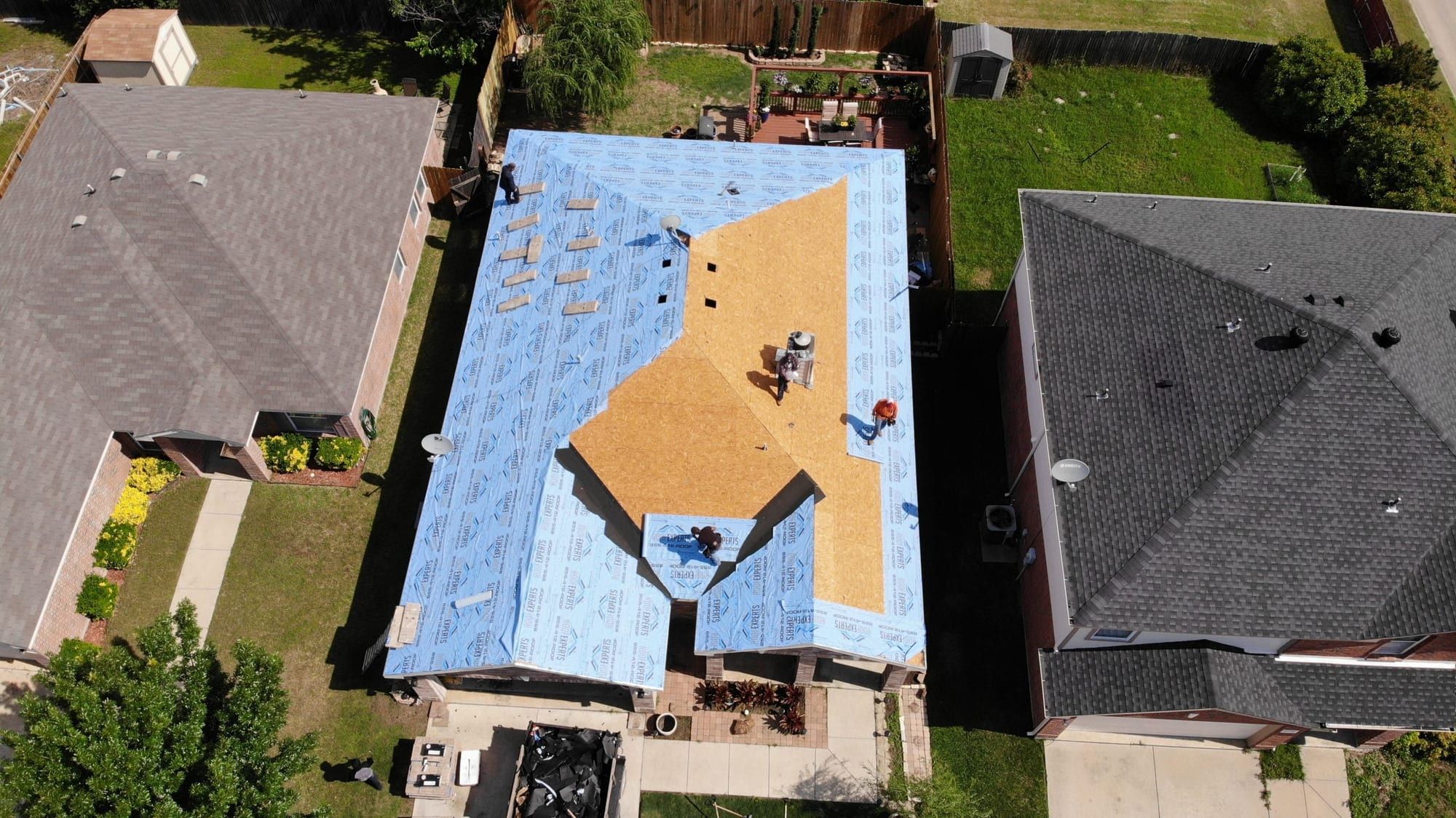
What sets the cost of a roof replacement in DFW?
Six things set most of the cost of a DFW roof: how many squares it has, its pitch, how many layers come off, the condition of the decking, the material you choose and whether you upgrade to Class 4. Access, tear-off and disposal, ventilation and flashing changes, and a city permit where one is required add to it.
No two roofs share the same mix, which is why Roof Experts prices each roof after we measure it and inspect the decking, flashing and ventilation. That inspection is free. The table shows what each item means on your roof and what to look for in a written quote.
| Cost driver | What it means on your roof | What to look for in the quote |
|---|---|---|
| Size and squares | One square is 100 sq ft of roof surface. Pitch and waste for cuts at hips and valleys are added to the flat footprint. | The number of squares, so you can check every quote against the same size |
| Pitch | Steep roofs need more safety setup, more staging and go slower. A 7:12 pitch or steeper usually counts as steep. | Whether a steep-roof charge is included or added later |
| Layers | Texas homes sometimes have a second layer of shingles nailed over the first. Both come off before the new roof goes on. | How many layers the roofer found and whether removing them is in the scope |
| Decking | Soft or rotted plywood often can’t be seen until the old shingles are off. | A per-sheet price for replacement decking, in writing, before work starts |
| Material | Architectural, Class 4, metal and tile each change the material and the labor. | The manufacturer and product line by name |
| Access | Two-story walls, tight lots, trees, pools and long carries slow material handling. | How the crew will stage, protect landscaping and reach the roof |
| Tear-off and disposal | Removing the old roof, hauling it away and sweeping for nails. | Dumpster, haul-off and magnet sweep listed in the scope |
| Ventilation and flashing | Intake and exhaust vents, pipe boots, wall and chimney flashing, drip edge. | Whether flashing is replaced or reused, and how the attic will be vented |
| Permit | A city permit and inspection, where the city requires one. Each city sets its own rules. | Whether the permit is part of the scope. See our Arlington and Fort Worth permit guide. |
Squares, pitch and waste
Floor area is not roof area. A roofer measures every slope, multiplies by a factor for pitch, then adds a waste allowance for the cuts at hips, valleys and rakes. A cut-up roof with many valleys and dormers needs more waste and more labor than a simple gable of the same size, so two homes with the same floor plan can carry very different numbers.
Material choice
The material changes the cost more than anything else you choose. It changes the product, the labor, the underlayment and the accessories, and some materials need a different deck or more structure. For how each material handles DFW hail and heat, see roofing materials.
| Material | How it changes the job | DFW notes |
|---|---|---|
| Architectural asphalt shingle | The baseline for most DFW homes | Wind-rated and widely available; standard shingles bruise in serious hail |
| Class 4 impact-resistant shingle | Same install as architectural, higher material cost | May earn an insurance premium credit; see below |
| Metal roofing | Different panels, trim and fasteners; specialized crew | Long service life and strong wind performance; costs more up front |
| Tile | Heavy; the structure has to be checked first | Slow, detailed install; usually the highest material and labor cost |
Is the Class 4 upgrade worth paying for?
Class 4 is the top impact rating under UL 2218. The Texas Department of Insurance says a Class 4 roof covering receives the highest premium credit, but each insurer sets its own discount. Ask your agent for the yearly credit in dollars, in writing, then compare it with the Class 4 line on your quote.
TDI’s form PC068, the impact-resistant roofing installation form, is completed by the roofing company; insurers may use it or require their own. More detail is on our Class 4 shingles page.
How does Roof Experts price a roof?
We price every roof after we measure it and inspect it, never from square footage over the phone. The inspection is free. We measure each slope, check the decking from the attic, look at flashing and ventilation, photograph what we find, and then write a line-item proposal for that roof with the product named.
- Inspect and measure. Every slope, the attic, the flashing, the vents and the number of layers.
- Show you the findings. Photos of what we found, so you are not taking our word for it.
- Write the scope. Product by name, underlayment, ventilation, flashing, drip edge, tear-off and disposal, and a per-sheet price for any decking that turns out to be bad.
- Price the options side by side. Architectural and Class 4, or other materials you are weighing, on the same scope.
- No surprises at tear-off. You see any bad decking before it is replaced.
Book a free inspection or call (817) 754-9484.
Insurance-funded roof or paying out of pocket
If covered hail or wind damaged the roof, your insurer pays for the covered damage minus your deductible, and an actual-cash-value policy also subtracts depreciation. If the roof is simply worn out, you pay for it yourself. The roof itself can be the same either way; what changes is who pays and how the scope gets set.
On a claim, the adjuster’s estimate sets what the insurer will pay for. We document the damage with photos, meet the adjuster on the roof and explain the process to you. We are not public adjusters and we don’t negotiate your claim for you. The Texas Department of Insurance notes that as roofs age, some companies switch roof coverage to actual cash value, so read your policy before the storm, not after.
How percentage deductibles work
Many Texas wind and hail deductibles are a percentage of your dwelling coverage, not a flat amount. That catches people out because the deductible grows with the value of the house, not with the size of the damage.
- On a policy with $300,000 of dwelling coverage, a 1% deductible is $3,000 and a 2% deductible is $6,000.
- TDI’s own illustration: on a home insured for $150,000, a 5 percent deductible is $7,500, so a covered loss smaller than the $7,500 deductible gets nothing from the policy (TDI, What to know about deductibles).
- Check whether your wind and hail deductible differs from your other deductibles. It is on the declarations page of your policy.
Nobody can waive your deductible
Texas law is clear on this. Business and Commerce Code §27.02 bars a contractor from waiving, rebating or absorbing your deductible, and Insurance Code Chapter 707 requires you, the policyholder, to pay it. TDI explains it on its page about contractors and deductibles. We never waive, rebate or cover a deductible. More on deductibles and ACV vs replacement cost.
Roof repair cost
What a repair costs depends on what failed, how hard it is to reach and how far the water spread. A few lifted shingles or a cracked pipe boot is a small job. Tracing a leak, rebuilding a valley, reflashing a wall or chimney, or replacing wet decking takes more time and material. We price the repair after we find the source.
What moves the cost of a repair:
- The component. Shingles, pipe boots, vents, flashing and valleys each take different material and time.
- Finding the leak. Water travels along the deck and rafters, so the stain on the ceiling is rarely under the hole. Tracing it is part of the job.
- Decking damage. Wet or rotted sheathing under the leak has to come out before the patch goes on.
- Matching. A discontinued shingle can mean a visible patch or a bigger repair to blend it in.
- Access and pitch. Steep, high or hard-to-reach slopes take more setup.
When repairs keep stacking up on an older roof, the money is usually better spent on a replacement. Our repair vs replace guide walks through how we make that call, and roof repairs covers what we fix.
Financing
Roof Experts offers in-house financing for specific situations, plus third-party financing for homeowners who would rather spread the cost of a roof over time. Ask about it during your free inspection so the payment plan is built around the same written scope as your quote, not added at the end.
Ask about financing during your estimate; options include in-house financing for some situations.
If your roof is an insurance job, the deductible is still yours to pay. TDI lists a copy of a payment plan with your contractor as one accepted proof that you paid it (TDI). Existing customers can pay invoices on our payments page.
How to compare roofing quotes
Compare quotes on an identical scope before you compare totals. Put the shingle line, underlayment, ventilation, flashing, drip edge, decking allowance, permit and disposal side by side. A low number that leaves out decking or flashing usually comes back as a change order once the old roof is off.
- Same product. The same manufacturer and shingle line on every quote, and the same impact rating if you want Class 4.
- Decking in writing. How much replacement decking is included, and the price for each additional sheet.
- Flashing and ventilation. Whether wall, chimney and pipe flashing is replaced or reused, and how the attic will be vented.
- Permit and cleanup. Whether the city permit is part of the scope where the city requires one, and how nails and debris are cleared.
- Warranty terms. Labor and manufacturer warranties described separately, in writing. Ours is a 5-year workmanship warranty on shingle roofs, covering our labor.
- Who you’re hiring. Texas does not license roofers, so ask for proof of insurance, a local address and city contractor registration. We are insured and registered with the City of Arlington, at 4275 Little Rd #202, Arlington, TX 76016.
- No deductible games. Walk away from anyone who offers to cover your deductible.
More on vetting a roofer is in how to choose a good roofing contractor in Texas. When you’re ready, book a free inspection or call (817) 754-9484.