
What should you do in the first hour after a roof leak?
Safety comes first, then stopping the spread of water, then documenting the damage. Stay off the roof, keep people away from any sagging ceiling, cut power to wet fixtures if it is safe to reach the breaker, and move belongings out of the way. Then photograph everything and call us at (817) 754-9484.
- Stay off the roof. Wet shingles and storm-weakened decking are dangerous, and wind can still be gusting.
- Cut power to wet fixtures. If water is coming through a light fixture or near outlets, switch that circuit off at the breaker, but only if you can reach the panel without standing in water.
- Watch the ceiling. A bulging ceiling is holding water. Keep people and pets out from under it.
- Contain the water. Buckets, towels and plastic sheeting over furniture. Move electronics, documents and rugs to a dry room.
- Photograph everything. Wide shots of each room, close-ups of stains and drips, and the outside of the house from the ground. Note the date and time.
- Call for a tarp. Tell us where the water is showing and what you can see from the ground.
- Report it to your insurer. If a storm caused the damage, start the claim promptly.
How does emergency roof tarping work?
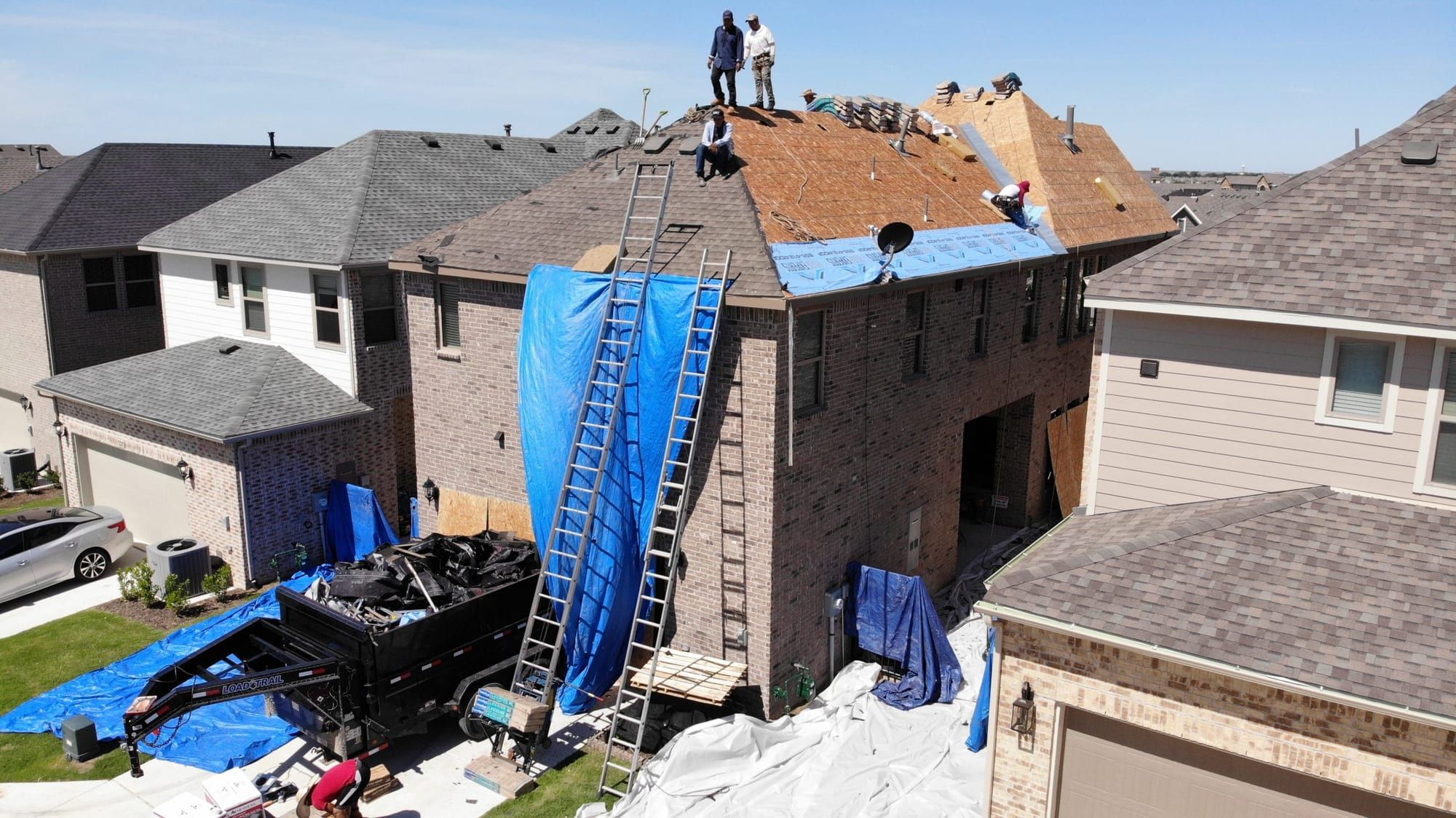
We offer emergency tarping: 24/7 emergency service, call anytime. A crew covers the damaged area with a heavy tarp that extends well past the damage, fastens it so wind can’t get under it, and seals the edges against wind-driven rain. Before the tarp goes on, we photograph the damage it will cover.
A properly placed tarp usually runs up and over the ridge so water can’t get in behind its top edge, and it is fastened through boards rather than with loose nails through the plastic. A tarp that flaps in the wind tears itself and the shingles under it, which is why the fastening matters as much as the cover.
Once the tarp is on, we explain what we saw, what the permanent repair is likely to involve, and what happens next. If the damage came from hail or wind, our storm damage page covers the full process after a storm.
What is the difference between a temporary and a permanent repair?
A temporary repair stops water from getting in today. A permanent repair fixes the cause so the roof is watertight for the long term. A tarp, a quick seal over a lifted flashing or a patch over a hole are temporary. Replacing damaged decking, shingles, flashing or vents and tying them into the rest of the roof is permanent.
| Temporary repair | Permanent repair | |
|---|---|---|
| Purpose | Stop water now | Fix the cause |
| Typical work | Tarp, sealant, temporary patch | New decking, shingles, flashing, vents |
| When | As soon as safely possible | Once the roof is dry and, with a claim, after the adjuster has seen it |
| How long it lasts | Until the repair is done | The life of the roof |
Some permanent repairs can be done in one visit. Others, such as replacing decking or a whole slope, need the roof to dry out first. Our roof repair page explains how we approach the permanent fix.
How should you document emergency damage for insurance?
Document before, during and after. Photograph the damage inside and out before anything is moved or covered, keep receipts for the tarp and anything you buy to protect the house, and write down the date and time the damage happened. That date becomes your date of loss, and the claim is tied to it.
We help with the roof side of that record. Our photos show the damage before the tarp went on, the tarp in place, and the condition of the roof around it. If you file a claim, we can meet the adjuster at the property and walk the damage with them. We are not a public adjuster, and the claim itself is between you and your insurer.
Most homeowners policies expect you to take reasonable steps to stop further damage after a loss, so keep the tarp invoice with your claim paperwork. Our guide to the roof insurance claim process explains each step after that first call, and the insurance claims hub covers deductibles, adjusters and payments.
When is a roof problem an emergency, and when can it wait?
It is an emergency when water is getting into the house or the roof structure is open to the weather. It is urgent, but usually not an emergency, when shingles are missing or flashing has lifted and no water has come in yet. Both need attention quickly, but only the first needs a tarp tonight.
Signs that can wait for a scheduled free inspection include granules in the gutters, a single lifted shingle, or an old stain that hasn’t grown. Our post on how to tell if your roof needs emergency repairs walks through the warning signs. After a major storm, check our storm updates for what we are seeing in the area.
Roof Experts, LLC has been based at 4275 Little Rd #202 in Arlington since 2017. For an active leak, call (817) 754-9484.