



What is the Commercial Roof Care Plan?
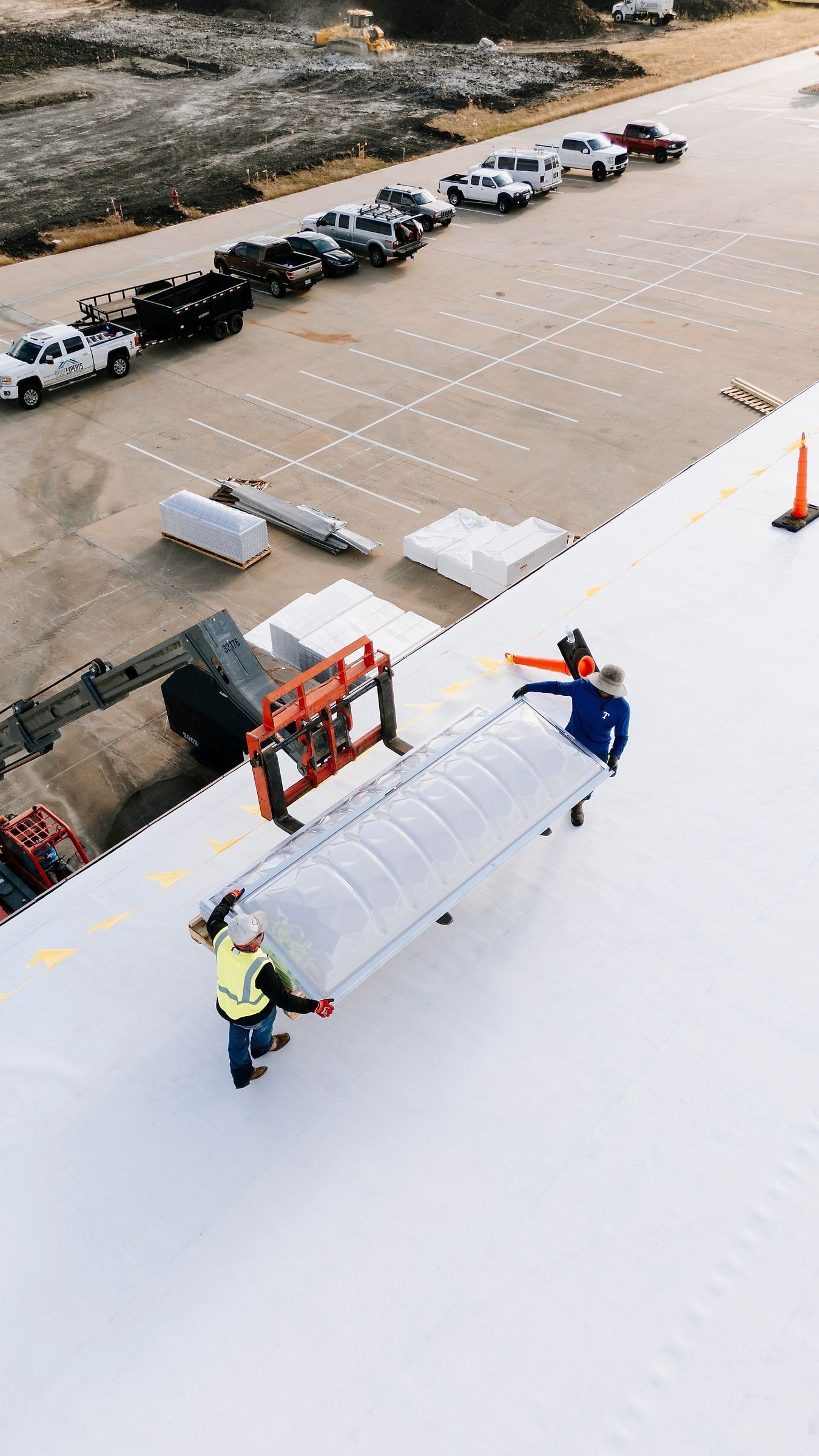
The Commercial Roof Care Plan is a scheduled roof maintenance program for commercial buildings in Arlington and Dallas–Fort Worth. Our crew inspects, cleans and makes minor repairs to every roof you manage on a set calendar, then sends a photo report with a condition score and an updated five-year budget. Small problems get fixed while they are still small.
It is built for people who answer to an owner, a board or a lender. Instead of finding out about the roof when a tenant calls about a ceiling tile, you get a written record of what the roof looks like twice a year (or four times on the Premier plan), what we fixed and what is coming. Replacement shows up in your capital plan years ahead instead of as a surprise.
Schedule a baseline roof assessment to get started, or call (817) 754-9484.
Why put a commercial roof on a preventive maintenance program?
Because most commercial roofs don’t wear out, they get worn out early by small failures nobody saw. Open seams, clogged drains and split flashings let water into the deck and insulation long before the membrane itself is done. A preventive roof maintenance program finds those on every visit and fixes them before water reaches the deck, insulation or tenants.
It makes the roof last. In a 15-year program across a national commercial portfolio, Firestone (now Elevate) reported that roofs on a maintenance plan lasted about 21 years, against about 13 for roofs that were only repaired when they leaked (Firestone Building Products ProLogis program, reported in Roofing Contractor, 2009).
You can budget with confidence. Every report carries a Roof Condition Index score and an updated five-year forecast, so the numbers in your operating budget or a lender’s capital plan come from the roof, not a guess.
It protects the warranty. Manufacturer roof warranties expect the owner to maintain the roof. A dated visit log and photo reports are your record that it was done. Manufacturer NDL warranties available.
What happens on every maintenance visit?
Every scheduled visit has four parts: a full inspection, cleaning, small repairs and a written report. A two-person crew walks every roof area, clears debris and drains, fixes the small things on the spot within the plan’s repair allowance, and you get a photo report within five business days showing what we found, what we fixed and what comes next.
- Inspect. A two-person crew walks every roof area with a 40-plus-point checklist covering the membrane, seams, flashings, drains, edges, penetrations and equipment curbs.
- Clean and clear. Debris comes off the roof, and drains, scuppers and gutters are cleared.
- Fix the small things. Sealant, pitch pans, small punctures and loose metal, inside the plan’s repair allowance.
- Report and forecast. A photo report within five business days: found, fixed, next, ranked by priority, with the condition score and five-year forecast updated.
What does a commercial roof inspection check?
Our inspection checks the whole roof system, not just the field membrane: the inside of the building, the roof surface, every seam and flashing, the edges and walls, every penetration and curb, the drainage, and where rooftop equipment meets the roof. Each item is rated Good, Fair, Poor or Critical, and every Poor or Critical item is photographed.
| Area | What we look at |
|---|---|
| Safety and access | Ladder or hatch condition, fall hazards, safe walking routes |
| Interior and history | Leaks since the last visit, other trades who have been on the roof, the underside of the deck where it can be seen |
| Field of the roof | Water still standing 48 hours after rain, debris, punctures, hail or impact marks, surface wear |
| Single-ply (TPO, PVC, EPDM) | Seams probed, splits, fastener back-out, EPDM seam tape, PVC embrittlement, TPO scrim showing through |
| Modified bitumen and built-up | Blisters, ridging, alligatoring, granule loss, open laps |
| Metal, coatings and steep-slope sections | Fasteners, panel seams, coating wear and adhesion, slope transitions |
| Perimeter, walls and edges | Edge metal, coping, base flashing height (8 inches minimum), counterflashing and termination bar, parapets, expansion joints |
| Penetrations and curbs | Pipe boots, pitch pans, HVAC, exhaust, hatch and skylight curbs, equipment supports and mounts |
| Drainage | Drains and strainers, overflow drains and scuppers, gutters, crickets |
| Rooftop equipment | HVAC condensate draining onto the membrane, kitchen exhaust grease containment, walkway pads, skylights and the hatch |
The photo standard is the same every visit: four corner overview shots, every drain and scupper, every rooftop unit curb and the access point. Every Poor or Critical item gets a wide photo for location and a close-up with a scale reference. After a storm we add hail-size reference photos. Because the shots repeat, you can compare one report to the last and see what changed.
What is a Roof Condition Index (RCI) score?
A Roof Condition Index is a single 0 to 100 score that tells you how a roof area is holding up and how soon it will need money. We score eight components from 1 (failed) to 5 (like new), weight each by how much it drives leaks and roof life, add them up and multiply by 20. The score sorts every roof into a budget band.
| Component | Weight |
|---|---|
| Field membrane or roof covering | 25% |
| Seams and laps | 15% |
| Base and wall flashings | 15% |
| Drainage | 15% |
| Penetrations and curbs | 10% |
| Edge metal and coping | 10% |
| Rooftop equipment interface | 5% |
| Surface condition and housekeeping | 5% |
RCI = sum of (weight x score) x 20.
For example, a roof scored 4 on the field membrane, 3 on seams, 3 on flashings, 2 on drainage, 4 on penetrations, 4 on edge metal, 3 on the equipment interface and 4 on housekeeping works out to 3.35 x 20 = an RCI of 67. That roof is in the Fair band: the membrane has life left, but the drains and seams are pulling it down, and fixing them now is what keeps it out of the Poor band.
| RCI score | Band | What it means for your budget |
|---|---|---|
| 85 to 100 | Excellent | Routine maintenance only |
| 70 to 84 | Good | Routine maintenance and scheduled repairs |
| 55 to 69 | Fair | Plan a restoration in 3 to 5 years |
| 40 to 54 | Poor | Major repair or restoration in 1 to 2 years |
| Under 40 | Critical | Budget a replacement |
On a building with several roof areas, each area gets its own score, so you can see that the roof over the warehouse is fine while the older office section needs money first.
How does the roof inspection report rank repairs?
Every finding in the report gets a priority, so a property manager can act on it without reading the whole thing twice. P1 items need action now, P2 items within six months, P3 items within twelve months, and M items are watched on the next visit. Each item has its photo, its location on the roof and what we recommend.
| Priority | Meaning |
|---|---|
| P1 Immediate | Active leak, a safety issue, or something that will leak this season |
| P2 | Repair within 6 months |
| P3 | Repair within 12 months |
| M Monitor | No work yet; check again next visit |
The report reads in three columns, found, fixed and next, and the five-year forecast at the end rolls the P2 and P3 items, the RCI band and the roof’s remaining life into one budget view you can hand to an owner or a lender.
Which maintenance plan fits your buildings?
Most buildings fit the Preferred plan: two scheduled visits a year with small repair labor and one post-storm inspection included. Essential suits a newer roof in good shape where you want the inspections and reports and will approve repairs as they come. The Premier plan suits busy roofs, older roofs and owners who want quarterly visits and the fastest leak response.
| Essential | Preferred (most popular) | Premier | |
|---|---|---|---|
| Scheduled visits per year | 2 (spring and fall) | 2 (spring and fall) | 4 (2 full inspections plus 2 drain and debris visits) |
| Photo report with condition score, every inspection | Yes | Yes | Yes |
| Debris removal; drains, scuppers and gutters cleared every visit | Yes | Yes | Yes |
| Minor repair labor included per visit | None; repairs quoted for your approval | Up to 1.5 crew-hours | Up to 2 crew-hours |
| Post-storm inspection and photo report | Available | 1 per year included | Included after every qualifying storm |
| Leak response target, on site | 3 business days | 2 business days | Next business day; emergencies same day |
| Leak investigation trips included | None | None | 2 per year |
| Workmanship warranty on repairs we perform on your low-slope or coated roof | 1 year | 1 year | 2 years |
| Annual budget review meeting | None | By request | Included, on site |
Crew-hours are on-roof hours for a two-person crew per scheduled visit.
You get all three plans priced for your roofs after the baseline assessment, so you compare them against your actual buildings.
How does the plan help after a North Texas hail or wind storm?
North Texas roofs take hail, high wind and long summers of heat and UV. A plan roof has a dated condition report from before the storm, and after a qualifying storm we inspect and photograph it against that report. That before-and-after record is what separates new storm damage from old wear when you talk to your carrier.
- After a storm you have proof. A dated condition report before, a post-storm inspection and photo report after. Roof Experts, LLC is a roofing contractor, not a public adjuster, and claim decisions are the owner’s. Our insurance claims page explains how we document storm damage.
- Hail and wind monitoring. When a qualifying storm hits near your property, we call you, inspect the roof and document it against the last report.
- Heat and UV. Texas summers age membranes and sealants. The spring and fall visits catch cracking, shrinkage and failing sealant before it opens up.
- Faster leak response. Plan members go to the front of the line, and emergency authorization is set up in advance, so the crew can start without waiting on an approval call. We offer 24/7 emergency service, call anytime.
How do you get started with a commercial roof maintenance plan?
Getting started takes one visit. We do a Baseline Roof Assessment of every roof area, then send a proposal with all three plans priced for your roofs and any repairs we recommend before the plan begins. Once you pick a plan, the visits go on the calendar and the reports come to your inbox.
- Baseline Roof Assessment. We inspect and measure every roof area, score its condition, estimate its remaining life and build a five-year budget. You keep the report either way.
- Pick a plan. You get a proposal with Essential, Preferred and Premier priced for your roofs, plus any repairs we recommend before the plan starts.
- We take it from there. Visits go on the calendar, site-access and emergency details go on file, and reports land in your inbox after every visit.
Schedule a baseline roof assessment or call (817) 754-9484.
Who is the Commercial Roof Care Plan for?
The plan is for anyone responsible for commercial roofs they don’t want to think about between budget cycles: property and asset managers with several buildings, single-building owners, and organizations whose roofs cover tenants, customers or students. One plan covers every roof you manage, each with its own score and forecast.
- Property and asset managers
- Retail and strip centers
- Office, flex and industrial buildings
- Restaurant and franchise groups
- Churches and private schools
- HOAs and multifamily clubhouses
- Medical and professional offices
Why choose Roof Experts, LLC for commercial roof maintenance?
Roof Experts, LLC handles upkeep, repairs, restoration and full replacement, so the company that maintains your roof is the one that can tell you honestly when it is time to restore or replace it. We have served Dallas–Fort Worth from our Arlington office since 2017. We’re insured, registered with the City of Arlington, and Elevate (Holcim), GenFlex and GACO certified.
When the RCI says a roof is in the Fair or Poor band, the next step is in the same report: a silicone or acrylic coating restoration if the roof qualifies, or a new TPO, PVC, EPDM or modified bitumen roof if it doesn’t. Our TPO vs PVC vs EPDM comparison lays out the single-ply options, and our commercial roofing services page covers everything else we do.
We’re rated 4.9 on Google. Our office is at 4275 Little Rd #202, Arlington, TX 76016. Office hours: Monday to Friday, 8 AM to 4 PM. Schedule a baseline roof assessment or call (817) 754-9484.